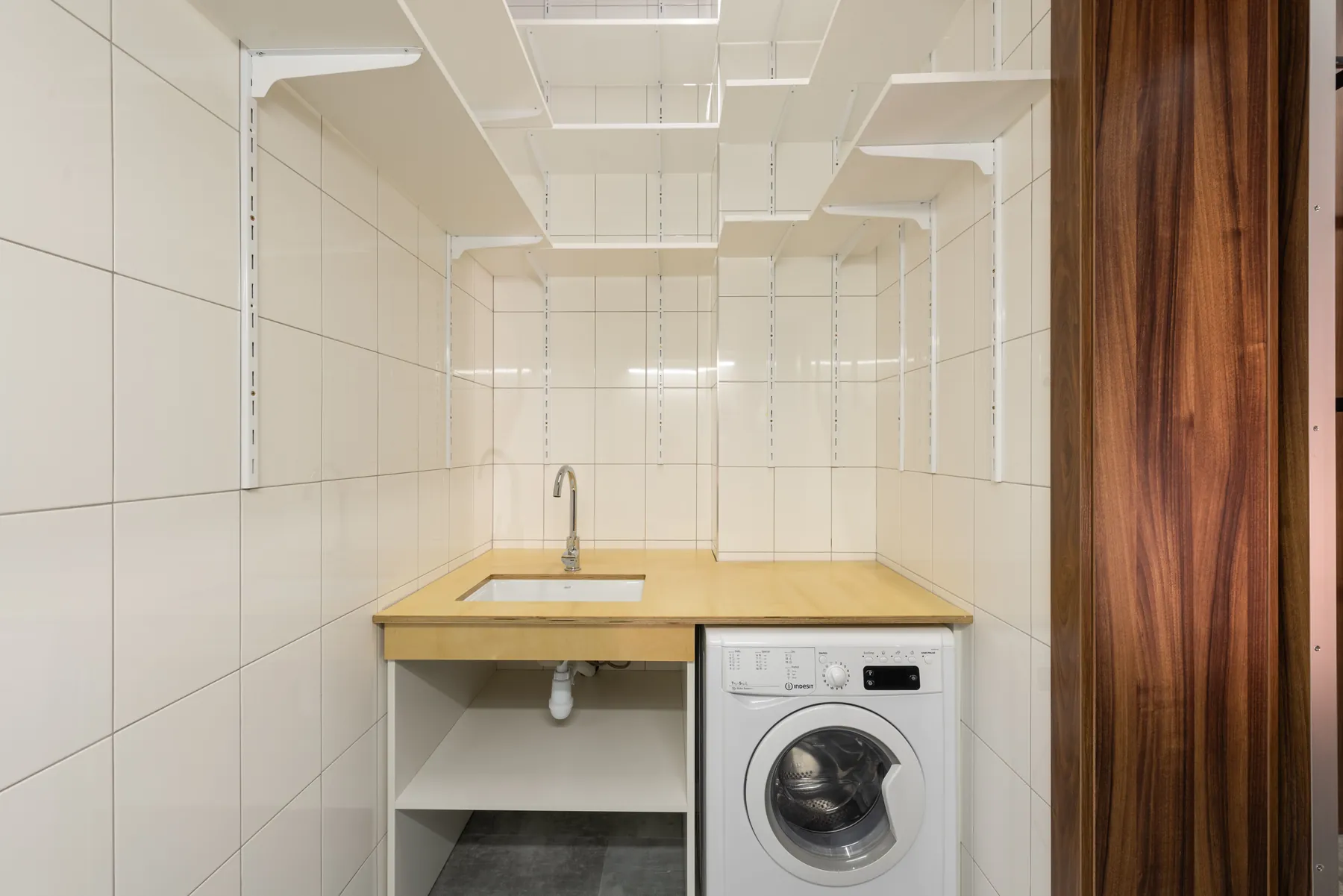
How to Organize Laundry Room
A laundry room does not need to be large or perfectly designed to work well. Even a small space can become easier to use when everything has a clear place, and your laundry routine follows a simple system.
If clothes, detergent bottles, baskets, and cleaning supplies tend to pile up, the problem may not be the size of your space. It may simply be that the room does not have an organization system that matches the way you actually do laundry.
If you are wondering how to organize laundry room spaces effectively, start with some practical changes. Sort clothes before washing, keep essential supplies within reach, maximize vertical space, and create a designated area for folding or air-drying.
This guide covers 15 practical ideas for organizing a laundry room, including small-space storage, laundry care labels, common laundry symbols, and what to know about white vinegar laundry uses.
What Makes a Laundry Room Easy to Organize?
A well-organized laundry room should make your routine easier rather than create more work.
Learning how to organize laundry room storage around your daily routine can make the space much easier to use.
Think about everything that normally happens in the room:
Sorting dirty clothes
Loading the washing machine
Measuring detergent
Treating stains
Drying clothes
Folding clean laundry
Hanging delicate garments
Storing towels and bedding
Dealing with items left in pockets
Once you know what activities take place in the room, it becomes much easier to decide where things should go.
For example, detergent belongs close to the washing machine, drying accessories should be near your drying area, and laundry baskets should be easy to reach when clothes are being sorted.
The best organization system is one that fits your routine instead of forcing you to change it completely.
1. Declutter Before Adding More Storage
Before buying baskets, containers, or shelving, take a good look at what is already in your laundry room.
Remove everything from cupboards, shelves, drawers, and baskets if possible. Then group similar items and decide what you actually use.
You may discover:
Empty detergent bottles,
Old cleaning products,
Damaged laundry baskets,
Unused hangers,
Broken clothes pegs,
Old stain removers,
Forgotten clothes,
And items misplaced from other rooms.
Getting rid of unnecessary items creates more useful space without spending money on additional storage.
It is tempting to solve every clutter problem with another container, but storage cannot fix a room that has too much stuff.
2. Create a Simple Laundry Sorting System
Sorting clothes before washing can become much easier when each type of laundry has a designated place.
Depending on your household, you might separate clothes into:
Whites
Dark colours
Colours
Towels
Bedding
Delicates
You do not need a separate oversized basket for every category. In a smaller space, two or three divided hampers may be enough.
For example, one hamper could be used for lights and another for darks, while towels and bedding are collected separately when necessary.
The important part is consistency. When everyone knows where dirty clothes belong, you are less likely to end up with one large mixed pile that needs sorting before every wash.
3. Make Better Use of Vertical Space
If your laundry room feels cramped, look at the walls before looking for more floor space.
Vertical storage can be especially useful in a small utility area because it gives you somewhere to keep everyday supplies without making the floor harder to move around.
Useful options include:
Floating shelves
Wall-mounted cabinets
Peg rails
Hooks
Hanging rods
Narrow shelving units
Over-door organizers
Store frequently used items in easily accessible locations, such as lower shelves or open areas. Items that are used less often can be placed on higher shelves or inside closed cabinets. Additionally, a narrow wall-mounted shelf can offer more effective storage than a bulky floor cabinet.
If you’re looking for more ways to use your walls and make the most of vertical space, explore our Laundry Room Shelving Ideas.
4. Give Laundry Products Their Own Zone
Detergent, stain remover, laundry bags, pegs, brushes, and other supplies can quickly make a laundry room look messy when they are scattered around the room.
Create one dedicated laundry-care area instead.
You can use:
Small baskets
Clear storage boxes
Pull-out drawers
Lidded containers
Shelf organizers
Labels can also help, especially if several people use the same laundry room.
For more practical ways to organize and store these everyday essentials, see our Laundry Room Storage Ideas.
For safety, keep laundry products securely stored and away from children and pets. Avoid transferring products into containers that could be mistaken for food or drinks.
5. Add a Dedicated Folding Surface
Having somewhere to fold clothes can make the entire laundry routine feel more organized.
If your washer and dryer sit side by side, a countertop above them can provide a convenient folding surface. You do not need a huge counter; even a relatively narrow surface can be useful.
For a smaller laundry room, consider:
A wall-mounted folding table
A narrow countertop
A fold-down work surface
A shelf that can double as a folding area
Try to keep this surface clear between laundry sessions. If it becomes a permanent storage area, you will lose one of the most useful features of the room.
6. Make Space for Air-Drying
Some clothes need more care than simply putting them in a tumble dryer.
A drying rack, hanging rail, or wall-mounted airer gives you a place to dry delicate garments naturally.
For a compact space, foldable or retractable options can be particularly useful because they can be put away when they are not needed.
You can also install a hanging rod for garments that need to dry on hangers.
Whatever solution you choose, position it so that it does not block access to the washing machine, dryer, cupboards, or walking area.
7. Store Laundry Baskets Efficiently
Laundry baskets can be useful, but they can also become one of the biggest sources of visual clutter.
Give them a dedicated storage location rather than leaving empty baskets around the room.
Depending on your layout, baskets can be:
Stored underneath a counter
Kept inside a tall cabinet
Placed on open shelving
Nested when empty
Stored inside a pull-out compartment
If different household members have their own baskets, labels can make clean-laundry distribution much easier.
For a small laundry room, look for baskets that can slide underneath counters or fit into narrow spaces.
8. Give Towels and Bedding Their Own Space
Towels, sheets, blankets, and other large textiles can take up a surprising amount of storage space.
Instead of allowing them to spread across several shelves, give them a dedicated area.
You can store:
Towels
Bed sheets
Pillowcases
Blankets
Spare bedding
Keep matching bedding together so that you do not have to search through several shelves when changing a bed.
If cupboard space is limited, use baskets or vertical shelves to keep folded linens contained and easy to access.
9. Create a Small Stain-Treatment Station
Some clothes need attention before they go into the washing machine.
A small stain-treatment area can keep everything you need in one place.
Depending on your routine, this could include:
Stain remover
Laundry brush
Reusable cloths
Small soaking container
Laundry-safe gloves
You can also keep a small basket for clothes that need special treatment before washing.
This is particularly useful if you often discover stains after clothes have already been placed in the main laundry hamper.
10. Keep a Small Bin for Pocket Clutter
Before putting clothes into the washing machine, check their pockets.
Coins, receipts, tissues, hair ties, and other small objects can easily end up in a wash if nobody notices them.
A small container beside the washing machine gives you somewhere to place these items instead of putting them on the nearest shelf.
You can empty the container regularly and return useful items to their proper locations.
It is a tiny change, but it can make your laundry routine more consistent.
11. Organize the Laundry Room Around Your Workflow
One of the simplest ways to improve a laundry room is to arrange it according to the order in which you actually use things.
A typical laundry workflow looks something like this:
Dirty clothes → sorting → washing → drying → folding → hanging → storage
Try to keep items close to the stage where they are needed.
For example, detergent should be near the washing machine, drying accessories should be close to the drying area, and your folding surface should be near where clean clothes come out.
This approach can make the room feel more efficient without requiring expensive renovations.
12. Understand Common Laundry Symbols
Laundry labels can sometimes look like a collection of mysterious little icons, but they are there to tell you how a garment should be cared for.
Common laundry symbols cover washing, drying, ironing, bleaching, and professional cleaning.
Understanding the basic symbols can help prevent accidental shrinking, colour damage, fabric damage, or unsuitable washing methods.
The Washing Tub Symbol
The tub symbol relates to washing.
You may see:
A tub containing a number — maximum washing temperature
A hand inside the tub — hand washing
A crossed-out tub — do not wash
Lines underneath the tub — gentler treatment may be required
Always follow the temperature and care instructions shown on the garment rather than assuming everything can be washed using the same programme.
The Square Symbol
The square relates to drying.
Different versions can indicate:
Tumble drying
Lower-temperature drying
Normal-temperature drying
Line drying
Flat drying
Drip drying
Do not tumble dry
If you are unsure about a drying symbol, check the complete care label before selecting a dryer programme.
The Iron Symbol
The iron symbol tells you whether and how the garment can be ironed.
Dots indicate the permitted temperature level.
A crossed-out iron means the item should not be ironed.
Using too much heat can damage some fabrics, so always follow the garment’s instructions.
The Triangle Symbol
The triangle relates to bleaching.
A plain triangle generally indicates that bleaching is permitted, while additional markings can provide more specific information.
A crossed-out triangle means the garment should not be bleached.
The Circle Symbol
The circle is associated with professional cleaning.
Letters inside the circle provide information for professional cleaners about appropriate cleaning processes.
A crossed-out circle means the item should not be dry-cleaned.
When in doubt, the care label should always take priority over a general laundry rule.
13. White Vinegar Laundry Uses: What Can It Actually Do?
White vinegar laundry tips are common online, particularly when people are looking for ways to deal with odours or detergent residue.
White vinegar contains acetic acid, which can help with certain types of residue and odours. However, it should not be viewed as a universal laundry product or a replacement for detergent.
One possible approach is using a properly diluted vinegar-and-water solution to pre-soak suitable washable items, followed by thorough rinsing before the normal wash.
Some people also use diluted white vinegar when dealing with residue on towels or clothing.
However, there is an important consideration when using vinegar around washing machines. Repeatedly putting vinegar directly into a washing machine may affect rubber and plastic components over time. For this reason, it is sensible to check the appliance manufacturer’s instructions before making vinegar part of your routine.
For washable garments, a separate pre-soak followed by rinsing can be a more cautious approach than routinely adding vinegar directly to the machine.
14. White Vinegar Uses Laundry: When Should You Be Careful?
There are many articles about white vinegar uses in laundry, but household cleaning advice should always be approached with some caution.
White vinegar should not be treated as a replacement for:
Laundry detergent
Fabric-specific stain removers
Manufacturer-recommended washing-machine cleaners
Professional cleaning where the garment requires it
Always check the garment care label, particularly when dealing with delicate or specialty fabrics.
Most importantly, never mix white vinegar with chlorine bleach. Combining acidic products with chlorine bleach can release dangerous chlorine gas.
If you are unsure whether vinegar is suitable for a particular garment or appliance, check the manufacturer’s instructions instead of experimenting.
15. Make the Laundry Room Easy to Reset
An organization system only works if you can maintain it.
You do not need to spend an hour cleaning the laundry room after every wash. A quick reset is often enough to keep clutter under control.
At the end of a laundry session:
Put detergent and supplies back in their usual locations.
Remove empty bottles and packaging.
Return laundry baskets to their storage area.
Clear the folding surface.
Check pockets before the next load.
Fold or hang clean clothes instead of leaving them in baskets.
Wipe up detergent or water spills.
Clean the lint filter according to your appliance instructions.
These small habits prevent the room from gradually returning to its old state.
How to Organize a Small Laundry Room
A small laundry room does not have to feel crowded.
If you’re working with a particularly small space, these Small Laundry Room Organization Ideas can help you make better use of every inch.
Knowing how to organize laundry room storage is especially useful when you are working with limited space.
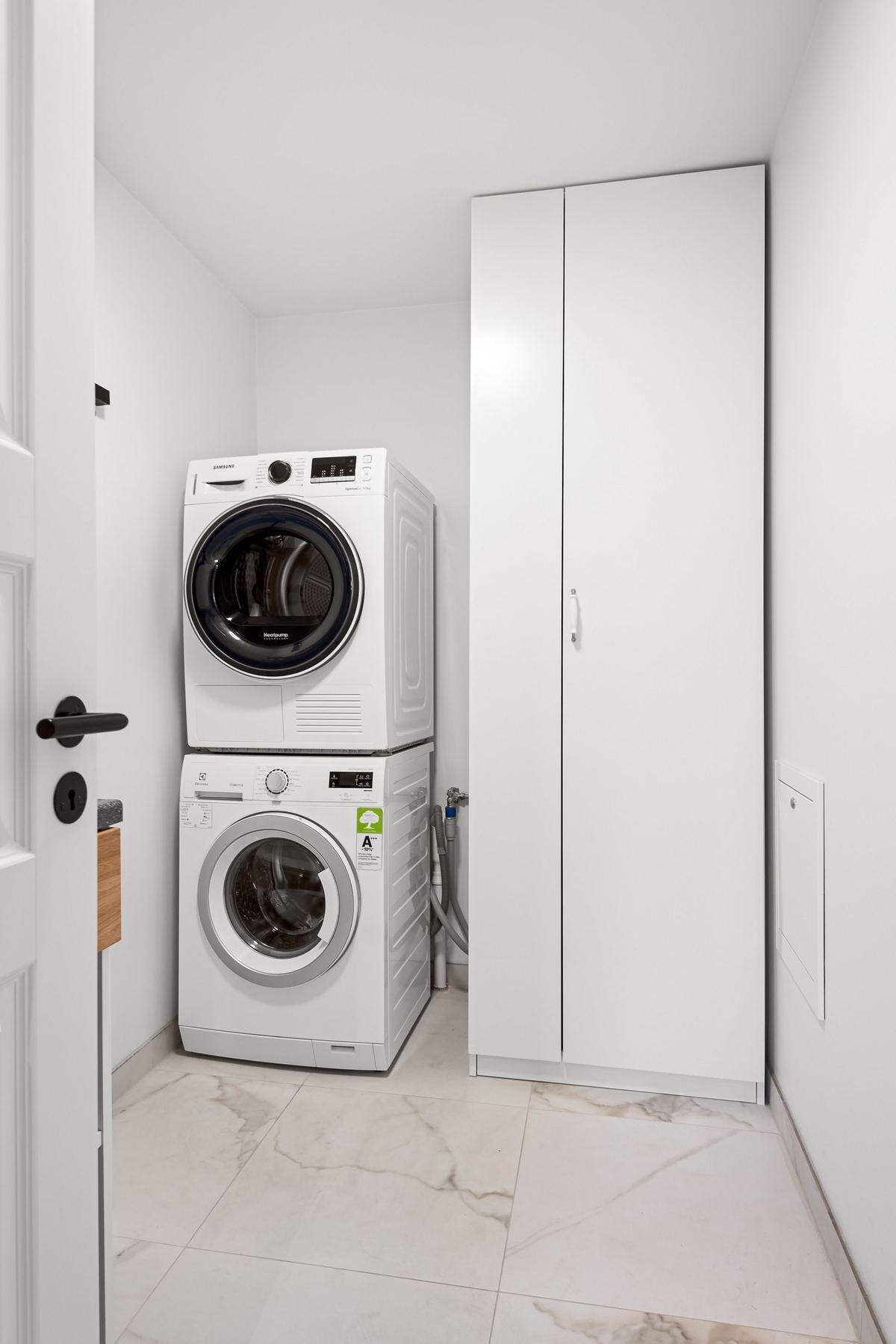
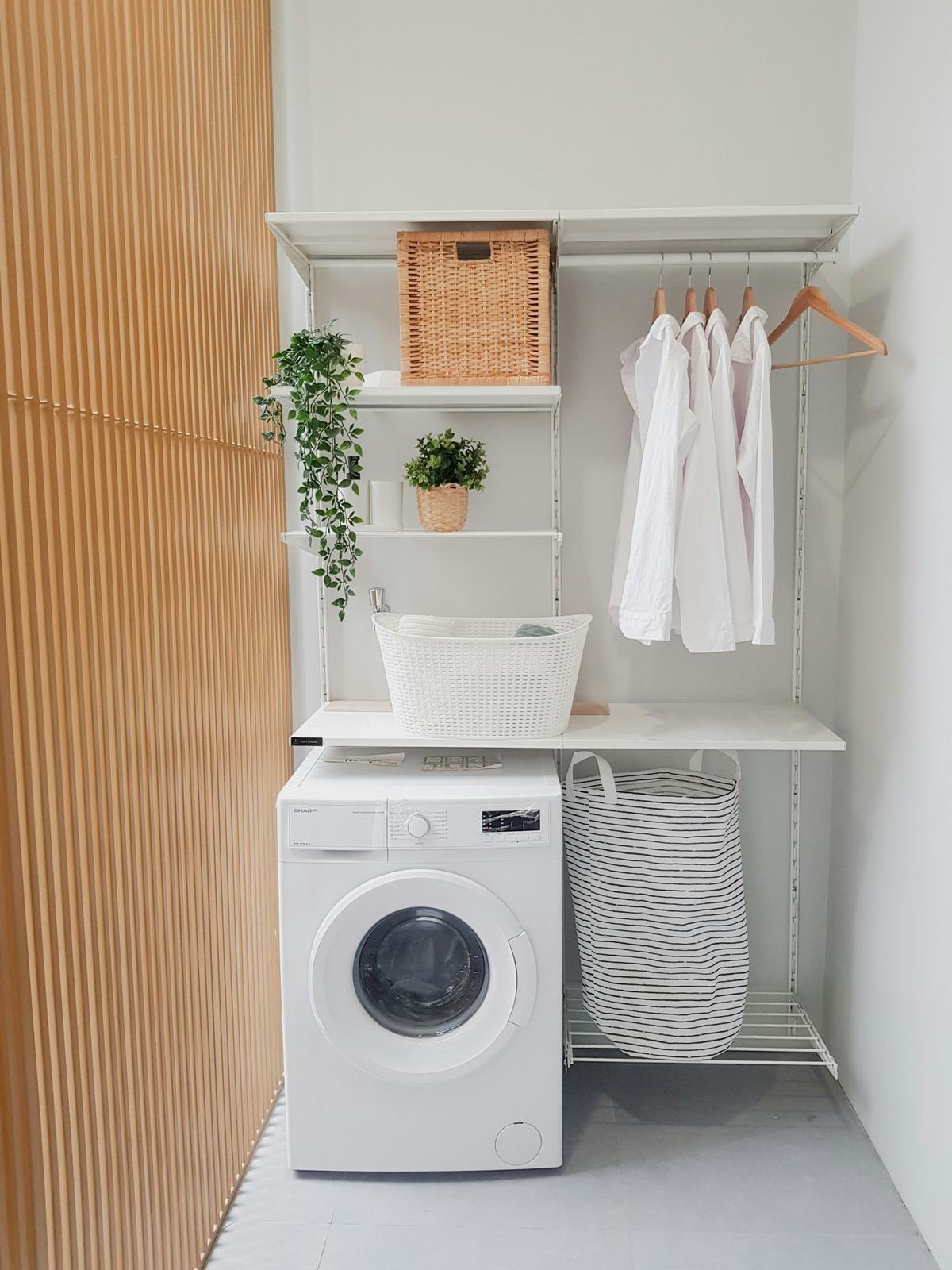
The first thing to consider is vertical space. Wall-mounted shelves, narrow cabinets, hooks, and drying solutions can provide useful storage without taking up much floor space.
If your washing machine and dryer allow it, the area above the appliances can also become valuable storage.
A countertop above front-loading machines can provide a useful folding surface, while a slim rolling cart can fit into a narrow gap beside an appliance.
For a very small space, consider combining:
- Stackable appliances
- Slim rolling carts
- Over-door storage
- Fold-down drying racks
- Wall-mounted hooks
- Narrow baskets
- Closed cabinets
The goal is not to fill every available space. Instead, make every storage area serve a specific purpose.
Laundry Room Organization Checklist
Use this checklist when organizing your space:
- Remove unnecessary items
- Create laundry sorting zones
- Add vertical storage
- Organize detergent and cleaning products
- Create a folding area
- Add a drying solution
- Store laundry baskets efficiently
- Create space for towels and bedding
- Keep stain-treatment supplies together
- Add a small pocket-items container
- Learn the main laundry symbols
- Follow garment care labels
- Use white vinegar carefully
- Keep cleaning products safely stored
- Create a simple reset routine
Frequently Asked Questions
How do I organize my laundry room?
Start by removing unnecessary items and then create separate areas for sorting, washing, drying, folding, and storage. Use vertical shelves, baskets, cabinets, and labeled containers to keep frequently used items easy to reach.
What should every laundry room have?
A functional laundry room should have space for sorting clothes, storing laundry products, drying clothes, and handling clean laundry. A folding surface is useful when space allows.
What are the most important laundry symbols?
The main laundry symbols explain washing, drying, ironing, bleaching, and professional cleaning. Numbers, dots, lines, and crossed-out symbols provide additional care instructions.
Can I use white vinegar in my laundry?
White vinegar has some household laundry uses, particularly for certain odours and residue-related tasks. However, it should not automatically be added to every washing-machine cycle, and you should check your appliance manufacturer’s guidance first.
Does white vinegar replace laundry detergent?
No. White vinegar is not a replacement for laundry detergent. Detergent is specifically formulated to remove dirt, oils, and stains from clothing.
Can I mix white vinegar with bleach?
No. Never mix white vinegar with chlorine bleach. The combination can release dangerous chlorine gas.
How can I organize a laundry room with very little space?
Use vertical storage, wall-mounted shelves, narrow carts, foldable drying racks, and storage above the appliances. Choose compact storage that fits your room rather than filling the floor with bulky furniture.
Final Thoughts
A well-organized laundry room does not have to look like a professionally designed utility space. It simply needs to make your everyday routine easier.
Start by removing things you do not use, then create clear places for dirty clothes, laundry products, drying items, and clean laundry. From there, use walls, shelves, baskets, and small storage solutions to make the most of the space you already have.
If your laundry room is small, focus on vertical storage and products that serve more than one purpose. If you have more space, create dedicated areas for sorting, washing, drying, and folding.
And when it comes to laundry care, do not overlook the information on clothing labels. Understanding laundry symbols can help you choose the right washing and drying method, while popular white vinegar laundry tips should be used carefully and according to garment and appliance instructions.
The best organization system is ultimately the one you can maintain. Keep everything in its place, reset the room regularly, and your laundry routine can become considerably easier to manage.